Nuclear Fusion: Singapore’s Next Frontier in Energy Collaboration
The Allure of the Holy Grail
Nuclear fusion has long carried the aura of being the holy grail of clean energy. The vision is seductive: limitless fuel drawn from seawater, no carbon emissions, no meltdown risk, and only minimal radioactive waste. In a fusion-powered world, energy would be abundant, safe, and endlessly renewable. But here’s the real question: is fusion truly the holy grail or a high hurdle that demands new kinds of collaboration to overcome?
For decades, fusion has been “thirty years away.” Now, that horizon is finally coming into view. From experimental breakthroughs in China to multi-billion-dollar projects like ITER in France and deep-tech startups such as Japan’s Helical Fusion, the 2030s could mark the dawn of demonstration plants and with them, a new global race for clean power can start.
Fission, Fusion, and the Global Race
To understand fusion’s promise, it helps to recall the difference between the two nuclears.
Fission – splitting atoms, powers today’s nuclear reactors. It’s reliable and carbon-free but burdened by waste, cost, and risk.
Fusion – by contrast, mimics the sun. By fusing hydrogen isotopes, it releases immense energy with almost no waste. The physics are proven; the engineering is the challenge ; sustaining plasma hotter than the sun and developing materials strong enough to contain it at scale.
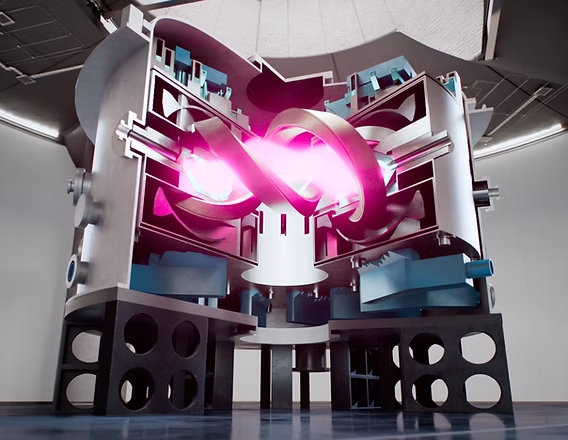
Global players are now in motion. Europe’s ITER and China’s EAST lead the scientific frontier, while the U.S. and U.K. host dozens of private startups. In Japan, Helical Fusion is taking a unique path developing a stellarator design that aims to combine stability, scalability, and commercial viability, with a roadmap to a demonstration plant by 2030 and the world’s first commercially viable fusion power plant by 2030s.
Singapore’s Energy Puzzle
Singapore stands at the intersection of immense energy demand and limited resources.
AI workloads, electric mobility, and vertical farming are driving up consumption, yet land scarcity and import dependency constrain its options. Despite these challenges, Singapore remains committed to net-zero emissions by 2050 and that means looking beyond conventional renewables.
In Budget 2025, the government announced plans to study nuclear technologies, including advanced small modular reactors. Fusion may not be ready yet, but Singapore’s stance is clear: stay prepared, stay adaptable, and engage early.
What Singapore Can Bring
Singapore may never host massive fusion reactors, but that doesn’t mean it can’t play a defining role. Its strength lies not in physics, but in building the frameworks, partnerships, and commercialization ecosystems that turn science into impact.
At the Innovation in Energy – Nuclear Fusion Dialogue, hosted by Leave a Nest Singapore with Helical Fusion and Hatch, participants explored how Singapore could accelerate the fusion story. A*STAR’s Andrew Ngo noted that Singapore’s research capabilities in aerospace and semiconductors could be repurposed to test materials and model extreme environments, foundations that take years to develop and should begin now. HY’s Matthew Chew added that Singapore could set the global gold standard for advanced reactors, developing digital twins and micro-grids to prepare for commercial deployment. CapitaLand’s Aylwin Tan emphasized the corporate view, pointing out that stable and predictable energy costs are essential to anchor operations in sectors like real estate, data centers, and food production, areas that could greatly benefit from the steady supply that fusion promises.
Together, these perspectives reflect a shared belief: fusion will need an ecosystem to succeed and Singapore can help build it.
Helical Fusion’s Role in the Partnership
For Helical Fusion, this collaboration represents more than market expansion, it’s about ecosystem building. As CEO Takaya Taguchi explained, “We believe the helical stellarator is the only approach that can meet the requirements for commercialization, steady-state operation, net electricity generation, and maintainability. Our roadmap is clear: a demonstration plant by 2030 and the world’s first commercially viable fusion power plant by 2030s”
By engaging with partners in Singapore early, Helical Fusion can tap into the region’s strengths in engineering talent, research testing, and commercialization networks. It’s a natural bridge: Japan’s frontier science meets Singapore’s applied innovation.
Singapore’s Frontier
Fusion may or may not be the holy grail but it is a mirror, reflecting how we think about collaboration, innovation, and preparedness. The roundtable revealed that Singapore’s strength is not in competing on plasma physics, but in becoming the hub where frontier science meets business and society. This is not just about energy, it’s about positioning Singapore at the heart of how humanity tackles its grandest technological challenges.
⚡ Fusion may remain a high hurdle, but how Singapore prepares for it, through partnerships like Helical Fusion, could very well be its next frontier opportunity! ⚡
Editor’s Note: Bridging Science and Society
As a science bridge communicator, our mission is to connect frontier researchers, startups, and businesses ensuring groundbreaking technologies like fusion don’t stay in labs but enter the real world through collaboration.
This article is part of that effort: to introduce Helical Fusion to Singapore’s innovation ecosystem and invite future partnerships that can turn science into sustainable impact.


